How to Overcome Snowmaking Constraints with Energy-Efficient Snow Guns
Snowmaking is an important part of modern ski resorts, indoor snow parks, and ice-snow entertainment projects. But achieving stable snow production is not simply a matter of choosing a powerful machine. Air temperature, humidity, water temperature, nozzle design, wind, and operating control all affect snow quality and system efficiency.
New-generation snow guns are designed to give project operators better control over these variables. With improved atomization, intelligent control, and remote operation, modern snowmaking systems can help projects make better use of suitable weather conditions while managing energy consumption more effectively.
How Do Snow Guns Improve Snowmaking Performance?
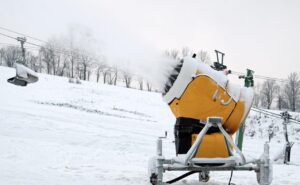
A snow gun sprays fine water droplets into the air. When environmental conditions are suitable, these droplets freeze and form artificial snow.
The challenge is that snowmaking performance changes with the environment. A system that works well under one set of conditions may require different settings when temperature, humidity, wind, or water temperature changes.
Better Control Under Challenging Conditions
The technical advantages of snow guns for stable operation under high-temperature conditions should be understood carefully. Snowmaking equipment cannot remove the basic physical requirements for water to freeze.
However, advanced snow guns can optimize operation within suitable environmental conditions. Better nozzle configuration, water control, airflow, and intelligent operating logic can help operators make better use of available snowmaking windows.
This is particularly useful for projects where operating conditions change throughout the day.
How Does Remote Control Help Reduce Ski Resort Energy Costs?
Energy consumption is a major concern for large snowmaking systems. Running every snow gun continuously is not always the most efficient approach.
Remote-control automatic snow guns can allow operators to manage equipment status, water supply, operating schedules, and different snowmaking zones from a central control system.
Smarter Snowmaking Instead of Continuous Operation
For example, operators can adjust equipment according to changing environmental conditions rather than using the same settings throughout the entire snowmaking period.
This approach may reduce unnecessary operation and improve coordination between snow guns, pumps, and other system components. The actual energy savings depend on project size, climate, equipment configuration, operating strategy, and electricity costs.
For large ski resorts, intelligent control therefore becomes more than a convenience—it can be an important part of overall operating management.
Why Does Snow Gun Nozzle Design Matter?
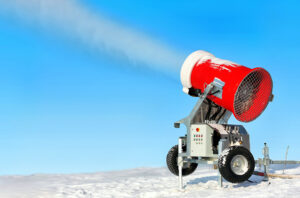
The nozzle is one of the key components affecting how water is atomized and distributed.
The influence of snow gun nozzle design on artificial snow quality and shooting range can be seen in several areas, including droplet size, spray pattern, snow distribution, and effective throwing distance.
Matching Nozzles to the Project
A longer shooting range does not automatically mean better snowmaking performance. The correct nozzle configuration should match the snow gun, water pressure, airflow, environmental conditions, and required coverage area.
For a ski slope, uniform snow distribution may be more important than maximum range. For an indoor snow park, operators may have different requirements for snow depth, coverage, and installation space.
This is why nozzle selection should be considered as part of the complete system rather than as an isolated component.
Domestic vs. Imported Commercial Snow Guns: What Should Buyers Compare?
The performance gap between domestic and imported commercial snow guns is often discussed by project owners. However, country of origin alone does not determine equipment performance.
Instead, buyers should compare measurable factors such as snowmaking capacity, nozzle configuration, control system, energy consumption, maintenance requirements, spare parts availability, installation support, and after-sales service.
A technically suitable system with reliable local support can sometimes be a better project choice than equipment selected only because of its origin.
How to Choose the Right Snow Guns for Your Project
Before purchasing snowmaking equipment, consider:
- Project type:ski resort, indoor snow park, snow tourism project, or entertainment venue.
- Environmental conditions:temperature, humidity, wind, and water temperature.
- Required snow output:determine the target production capacity and snow coverage.
- Installation area:consider shooting distance, layout, and snow distribution.
- Control requirements:decide whether automatic or remote control is needed.
- Long-term operation:evaluate energy consumption, maintenance, spare parts, and technical support.
A complete engineering assessment is more reliable than selecting equipment based on capacity alone.
FAQ About Snow Guns
Can snow guns make snow in warm weather?
Snowmaking depends on environmental conditions, especially wet-bulb temperature. Advanced equipment can improve the usable operating window, but it cannot eliminate the physical conditions required for water to freeze.
Do more powerful snow guns always make better snow?
Not necessarily. Snow quality depends on the complete system, including nozzle design, water conditions, airflow, and environmental factors.
Are remote-control snow guns worth the investment?
For larger projects, remote control and automatic operation can improve equipment coordination and operating efficiency. The value depends on project scale and control requirements.
Build a More Efficient Snowmaking System with Focusun
Choosing snow guns is not only about machine capacity. The right solution should consider environmental conditions, snow quality, energy management, system layout, and long-term operation.
With more than 20 years of experience in refrigeration and ice-making technology, Focusun provides customized engineering solutions for ice and snow projects. Contact our team to discuss your project requirements and find a snowmaking configuration suited to your operating conditions.